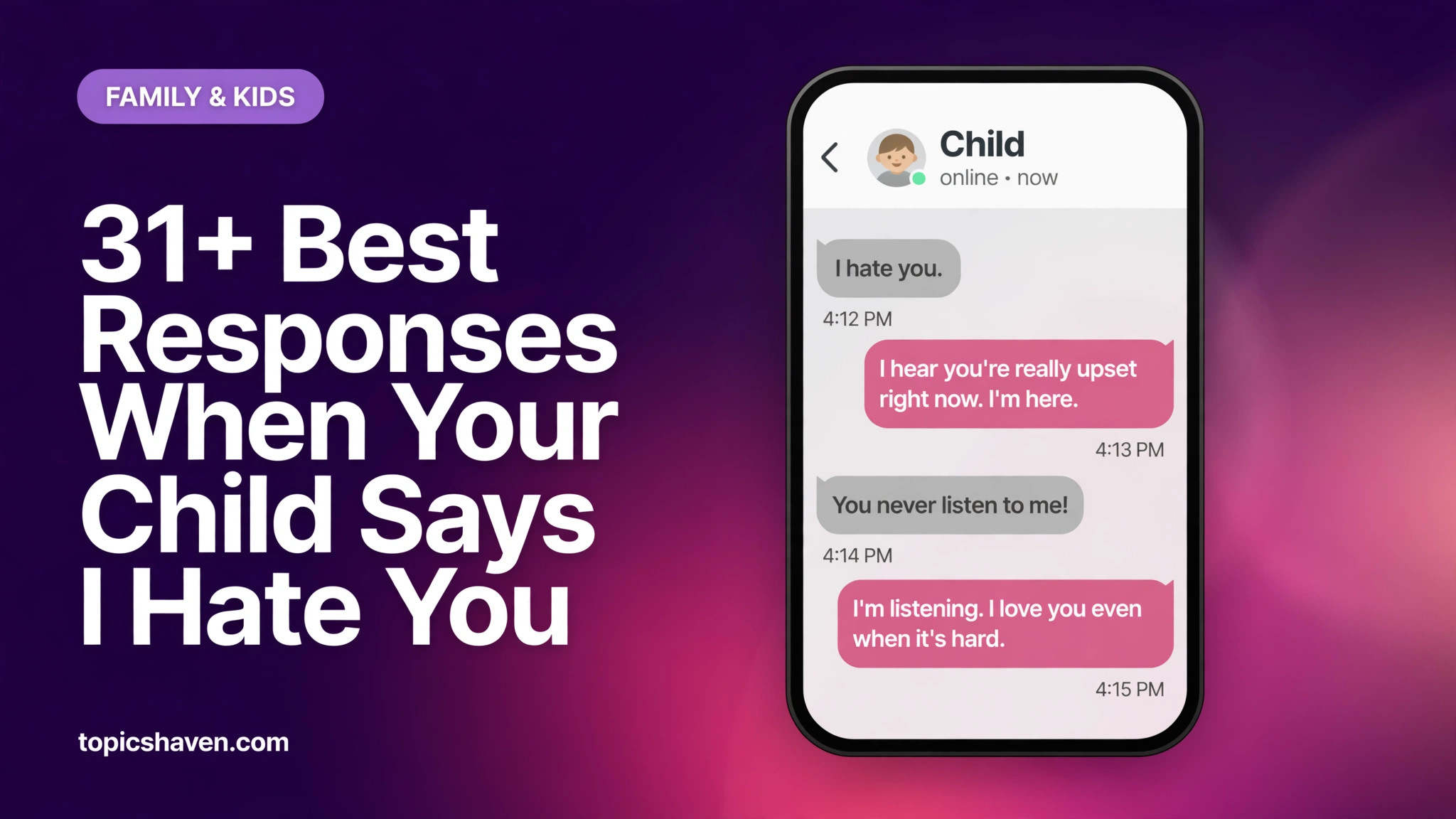
31+ Best Responses When Your Child Says I Hate You (100+ Examples)
Hearing “I hate you” from your own child can feel like a punch to the heart, even when you know it’s just big feelings in small words. Kids between 2 and 10 say it because their emotional vocabulary hasn’t caught up with their emotional experience. The right responses when your child says “I hate you” can turn a meltdown into a moment of connection. Below are 22 copy-and-paste replies, organized by age and situation, so you can stay calm and keep your bond strong.
📌 Jump to
- Calm, Loving Replies for a Toddler
- Replies That Validate the Feeling, Not the Words
- Replies for a School-Age Kid in a Big Meltdown
- Replies for a Teen Testing Boundaries
- What to Say Later, When Everyone’s Calm
Calm, Loving Replies for a Toddler
Toddlers borrow big adult words to describe huge feelings. Stay short, stay warm, and don’t try to reason mid-storm.
- “I hear you. You’re really upset right now, and I love you.”
- “That’s a big feeling. I’m right here with you.”
- “You sound so angry. It’s okay, I’m not going anywhere.”
- “I love you, even when you’re mad.”
- “Those are loud feelings. Let’s breathe together.”
Replies That Validate the Feeling, Not the Words
Child psychologists call this “connect before you correct”, acknowledge the emotion first, and the hurtful words lose their power.
- “I can tell you’re really angry. I love you anyway.”
- “You don’t have to love me right now, but I will always love you.”
- “It sounds like something feels really unfair to you.”
- “I hear the anger behind those words. Tell me what’s wrong.”
- “Your feelings are okay. Those words hurt, though, can we try different ones?”
Replies for a School-Age Kid in a Big Meltdown
School-age kids are old enough to feel embarrassment on top of anger. Give them space, dignity, and a door back in.
- “I’m going to wait right here until you’re ready to talk.”
- “We can talk about this when the feelings aren’t so loud.”
- “I understand you’re angry at me, and it’s okay to be angry.”
- “I love you too much to let big feelings win tonight.”
Replies for a Teen Testing Boundaries
Teens use “I hate you” to test whether love survives conflict. Hold the boundary and the relationship at the same time.
- “I get that you’re furious. You still can’t talk to me that way.”
- “I’m not going to fight with you, but I’m not walking away either.”
- “Say it differently and I’ll listen. I’m here.”
- “You can be angry and still be respectful, I know you can do both.”
What to Say Later, When Everyone’s Calm
The real teaching moment comes after the storm passes. A calm follow-up turns a rough day into a lesson they’ll keep.
- “Earlier was tough. Want to tell me what was really going on?”
- “I wasn’t scared by your anger, but I was a little sad. Can we figure this out together?”
- “Next time you’re that mad, try saying ‘I’m so angry’ instead. I’ll listen faster.”
- “No matter how mad we get, we’re still a team. Okay?”
Tips for the Perfect Reply
- Stay calm first: Your nervous system sets the tone for the whole house. Take one slow breath before you speak, your child will borrow your calm.
- Don’t take the words personally: Psychologists point out that kids save their biggest outbursts for the safest person in the room, that’s you, and it’s actually a sign of trust.
- Connect before you correct: Name the feeling (“You’re furious”) before you address the language (“We don’t use those words”). The feeling needs a listener; the words need a boundary.
- Never say it back: Even as a joke, “I hate you too” lands like a brick on a flooded brain. Say “I love you” instead, it takes the power out of the phrase.
- Don’t cave on the boundary: Giving in right after “I hate you” teaches your child that the phrase works. Hold the limit warmly, then reconnect.
- Get the expert playbook: Child psychologists break down how to react when your child says “I hate you”, empathy first, respectful boundaries always.
Frequently Asked Questions
Is it normal for a child to say “I hate you”?
Yes, completely normal, especially between ages 2 and 10. Children’s brains develop big emotions long before they develop the vocabulary to express them, so “I hate you” becomes the loudest word they have. It usually means “I’m overwhelmed,” not “I reject you.”
Should I punish my child for saying “I hate you”?
Punishing the words doesn’t teach better words, it just teaches your child to hide big feelings. Address the language calmly later (“In our family we say ‘I’m angry’ instead”), but treat the outburst itself as a signal that your child needs help, not punishment.
What if my child says it every single day?
If it becomes constant, or comes with aggression, withdrawal, or trouble at school, look for what’s underneath, stress, sleep issues, or something they’re struggling to name. A calm daily check-in helps, and a child counselor is worth a visit if the pattern won’t shift.
Final Thoughts
An “I hate you” from your child is really code for “I’m overwhelmed and I need you.” Answer with calm, love, and a clear boundary, and you’ll teach them that love survives even the loudest feelings. For more help with tough parenting moments, see our guides on what to say when your child says hurtful things and when your child is disrespectful, and the free Reply Finder tool at Topicshaven is always there when you’re stuck for words.
Leave a Reply