Blog

  • 31+ Best Responses When Your Boss Asks for Feedback (100+ Examples)

    31+ Best Responses When Your Boss Asks for Feedback (100+ Examples)

    31+ Best Responses When Your Boss Asks for Feedback (100+ Examples)

    “So, how do you think I’m doing as your manager?” Your stomach drops. Be too honest and you risk your job; say “everything’s great” and you waste a rare opportunity. The best responses when your boss asks for feedback are honest, specific, and kind: “I appreciate you asking, one thing that would help me is…,” “Can I think on it and share tomorrow?” or “The weekly check-ins have been great for me.” Below are 22 copy-and-paste scripts for giving upward feedback safely, from safe openers to tactful hard truths.

    ๐Ÿ“Œ Jump to

    The Safe-Honest Opener

    Start by appreciating the ask. It buys you goodwill and a few seconds to think, both are valuable.

    1. “I really appreciate you asking, that says a lot about you as a manager.”
    2. “Thanks for opening the door to this. I’d love to share a thought.”
    3. “I’m glad you asked. Is now a good time for something honest?”
    4. “That means a lot. Give me a second to gather my thoughts.”
    5. “Honestly, the fact that you’re asking is already a great sign.”

    Giving Real Upward Feedback

    Real feedback is specific, behavioral, and framed as your experience, never as a verdict on their character.

    1. “One thing that would help me: clearer priorities when everything feels urgent.”
    2. “In our last project meeting, I noticed decisions got revisited a few times. Locking them in earlier would help.”
    3. “I do my best work with a little more heads-up on deadlines, even a day helps.”
    4. “When feedback comes right after a win too, not just mistakes, it keeps me motivated.”
    5. “Could we try a quick weekly check-in? Even fifteen minutes would keep me aligned.”

    When You Need Time to Think

    Never improvise upward feedback on the spot. Asking for time is smart, not evasive.

    1. “Can I think on it and share something thoughtful tomorrow?”
    2. “I’d rather give you a real answer than a rushed one, can we revisit this Friday?”
    3. “Let me reflect and bring you two or three honest thoughts next week.”
    4. “I want to do this well. Mind if I send you my thoughts in writing?”

    Keeping It Positive

    Sometimes the honest answer is genuinely good. Say it specifically, vague praise helps no one.

    1. “Honestly, the weekly check-ins have been great for me, please keep those.”
    2. “You give clear direction and then trust me to run with it. That’s rare.”
    3. “I feel supported here, and that starts with you.”
    4. “The way you handled the last crunch showed real leadership. More of that.”

    When the Truth Is Uncomfortable

    For the hard stuff, use the behavior-impact-request formula: what happened, how it affected you, what you’d like instead.

    1. “You may not have realized, when plans change last-minute, it throws my whole week. A heads-up would help.”
    2. “In yesterday’s meeting I felt cut off mid-point. I’d love space to finish my thoughts.”
    3. “I know you mean well, but public criticism lands hard on me. Private feedback works better.”
    4. “My intention is for us to work better together: clearer timelines would make a big difference for me.”

    Tips for the Perfect Reply

    • Be specific or be silent: “Communication could improve” is useless. “A heads-up on deadline changes would help me” is gold. Specifics are safe; vague complaints sound like attitude.
    • Frame it as your experience: “I felt…” and “I noticed…” keep it about observable behavior. “You always…” and “You never…” make it about character, and start fights.
    • Ask permission first: Even when they asked, check: “Is now a good time for something candid?” It gives them a second to brace, and makes them far more receptive.
    • Do it privately: Never give your boss critical feedback in front of others. Private praise, private critique, no exceptions.
    • End with gratitude: Close with “Thanks for listening, it makes me proud to be on this team.” It seals the conversation on warmth, whatever you said before it.
    • Study the upward-feedback playbook: Leadership coaches at Radical Candor explain how to give your boss feedback without fear, the golden rules: do it now not later, stick to facts, and never make it about who they are.
    • Balance honesty with grace: If you ever freeze mid-conversation, our responses for when you don’t know what to say will get you unstuck.

    Frequently Asked Questions

    Should I be 100% honest when my boss asks for feedback?

    Be honest about behaviors and your experience, but choose your battles. Share feedback that helps you both work better, not every irritation needs airtime. Honest, kind, and useful beats brutally honest every time.

    What if my boss gets defensive about my feedback?

    Stay calm and clarify your intent: “I’m sorry you’re upset, my goal is for us to work better together, not to criticize.” If they stay heated, suggest revisiting later. Some bosses need time to digest.

    Is it a trap when my boss asks for feedback?

    Usually not, most managers genuinely want to improve. But read the room: if your boss has punished honesty before, keep it light and positive. Trust is earned, and you don’t owe vulnerability to someone who hasn’t earned it.

    Final Thoughts

    Being asked for feedback is a compliment, it means your voice matters here. Be specific, be kind, and always do it privately. And when the tables turn and praise comes your way, our guide on responses when your boss compliments you shows how to accept it gracefully, plus the free Reply Finder tool at Topicshaven is always there when you’re stuck for words.

  • 27+ Best Responses When Your Boss Yells at You (100+ Examples)

    27+ Best Responses When Your Boss Yells at You (100+ Examples)

    27+ Best Responses When Your Boss Yells at You (100+ Examples)

    Your boss is yelling, your heart is pounding and every instinct says fight or flee. Don’t do either. The best responses when your boss yells at you are calm, short, and boundary-setting: “I want to hear you, and I can do that better when we’re calm,” “I’m willing to discuss this when we can speak respectfully,” or “Could you repeat that?” Below are 22 copy-and-paste scripts for the heat of the moment and the calm follow-up after, all professional, all job-safe.

    ๐Ÿ“Œ Jump to

    Calm De-escalators

    Your steady voice is your superpower. These lines lower the temperature without surrendering your dignity.

    1. “I want to hear what you’re saying, and I can do that better when we’re calm.”
    2. “I understand you’re upset. Let’s slow down and work through this.”
    3. “I hear you. Take a breath with me and let’s talk it through.”
    4. “I’m not going anywhere, I just need us to talk, not shout.”
    5. “Let’s pause for a second. I want to get this right.”

    Firm Boundary Lines

    You don’t have to accept being yelled at, by anyone. These draw the line clearly and professionally.

    1. “I’m willing to discuss this when we can speak respectfully.”
    2. “I’m not willing to be yelled at, but I’m glad to talk once we’re calm.”
    3. “I can’t take in what you’re saying while you’re yelling.”
    4. “I do great work for this team, and I’d like to be spoken to accordingly.”
    5. “If you have something professional to say, I’m listening.”

    The “Repeat That” Technique

    Asking a yeller to repeat themselves is quietly brilliant, almost nobody can shout the same insult twice with a straight face.

    1. “Sorry, I didn’t catch that. Could you repeat it?”
    2. “Could you say that again, calmly, so I can address it properly?”
    3. “I want to make sure I understand, what did you just say?”
    4. “Let’s rewind. Tell me the actual problem and I’ll fix it.”

    Exit Lines: Leaving the Room

    Walking away from yelling is not quitting, it’s the most professional move available. Say one line, then go.

    1. “I’m going to step out. We can continue this when we’re both calm.”
    2. “This isn’t productive right now. I’ll be at my desk when you’re ready.”
    3. “I need to excuse myself. Let’s schedule time to talk this through.”
    4. “I’m leaving this conversation, not the job. We’ll talk later.”

    After the Yelling: Follow-Up Scripts

    The follow-up is where the real boundary gets set. Have it within a day, while it’s fresh for both of you.

    1. “About yesterday, yelling doesn’t work for me. Can we handle things differently?”
    2. “I want us to have a good working relationship, and that means no shouting.”
    3. “I’ve noted what happened. I’d like your commitment that it won’t happen again.”
    4. “I’m bringing this up because I respect you and this job. Let’s reset.”

    Tips for the Perfect Reply

    • Never yell back: The second you match their volume, you lose the high ground, and in any HR review, the recording favors the calm one.
    • Don’t say “calm down”: Those two words have never calmed anyone down in history. Try “I want to hear you, let’s do this calmly” instead.
    • Keep your body still: Unclench your jaw, drop your shoulders, keep your voice low and slow. Your body tells them you’re not a threat, and not a target.
    • Document the incident: Date, time, place, exact words, witnesses. If yelling becomes a pattern, this log turns a complaint into a case.
    • Know the difference: Harsh feedback about your work is not the same as personal abuse. If it’s insults and humiliation, that’s a different conversation, see our responses when someone disrespects you.
    • Trust the expert script: Workplace advisor Alison Green recommends exactly this line: tell your boss you’re not willing to be yelled at, then leave and offer to talk later once the yelling stops.

    Frequently Asked Questions

    Can I walk away when my boss is yelling at me?

    Yes. Politely ending an abusive conversation, “I’m going to step out; we can continue when we’re calm”, is professional, not insubordinate. You have the right to not be subjected to verbal abuse at work.

    What if my boss yells at me in front of others?

    Stay composed, your calm in front of witnesses actually strengthens your position. Use a short boundary line, exit if needed, and follow up privately later. Witnesses also make your documentation stronger.

    Is it normal for bosses to yell?

    Common, but not acceptable. Occasional raised voices happen under stress; a pattern of yelling creates a hostile work environment and may give you grounds for an HR complaint. One incident deserves a conversation; a pattern deserves documentation.

    Final Thoughts

    No one, not even your boss, gets to yell at you. Stay calm in the moment, set the boundary, and follow up when it’s quiet. If anger shows up in other relationships too, our guide on responses when someone is angry can help, and the free Reply Finder tool at Topicshaven is always there when you’re stuck for words.
  • 32+ Best Responses When Your Boss Wishes You Happy Birthday (100+ Examples)

    32+ Best Responses When Your Boss Wishes You Happy Birthday (100+ Examples)

    32+ Best Responses When Your Boss Wishes You Happy Birthday (100+ Examples)

    “Happy birthday! ๐ŸŽ‰” pops up in Slack from your boss, and suddenly you’re overthinking a two-word reply. Relax. The best responses when your boss wishes you happy birthday are warm, short, and professional: “Thank you so much!”, “Appreciate it, it made my day,” or “Thanks! Looking forward to a great year with the team.” Below are 22 copy-and-paste replies for every channel, from quick DMs to team threads to the surprise office cake.

    ๐Ÿ“Œ Jump to

    Quick Professional Replies

    For a direct message from your boss, short and sincere wins. No need to write a speech.

    1. “Thank you so much!”
    2. “Thank you, I really appreciate you remembering.”
    3. “Thanks! That made my morning.”
    4. “Appreciate the kind message. Thank you!”
    5. “Thank you! Grateful to be on this team.”

    Warm Replies With Personality

    When you have a good rapport with your boss, add one personal touch, a name, a detail, a little warmth.

    1. “Thank you, Sarah! Your message was the first one I saw today.”
    2. “Thanks so much, that really made my day.”
    3. “I appreciate that! Looking forward to a great year with the team.”
    4. “Thank you! Feeling lucky to work with people like you.”

    Group Channel & Team Thread Replies

    When the wish lands in a public Slack or Teams channel, thank the group once, warmly, then move on.

    1. “Thank you, everyone! You all made my day. ๐ŸŽ‰”
    2. “Thanks team! Feeling the love today.”
    3. “Thank you all for the wishes, best team ever.”
    4. “Appreciate all the birthday love! Back to crushing our goals. ๐Ÿ’ช”

    When They Sent a Gift or Cake

    A gift deserves a specific thank-you. Name what they did, it shows you actually noticed.

    1. “Thank you so much for the cake, it was delicious!”
    2. “The gift was so thoughtful. Thank you!”
    3. “Thanks for organizing the surprise, you didn’t have to, and it meant a lot.”
    4. “Thank you! The card from the team is going straight on my desk.”
    5. “I’m really touched. Thank you for making my birthday special at work.”

    Funny-but-Safe Replies

    Humor is fine with a boss you know well, keep it self-deprecating, never edgy, and only in a casual culture.

    1. “Thank you! Officially accepting that I’m wiser, not older.”
    2. “Thanks! Do I get the day off as a birthday bonus? Asking for a friend. ๐Ÿ˜„”
    3. “Thank you! I’ll try to be extra productive before the cake coma hits.”
    4. “Thanks! Same time next year, I’ll bring the cake.”

    Tips for the Perfect Reply

    • Use their name: “Thanks, David!” feels ten times more genuine than a bare “Thanks!” It takes half a second and buys real goodwill.
    • Match the channel: A quick emoji reaction works in a busy group thread; a personal DM from your boss deserves actual words.
    • Keep it short: Two sentences max. A paragraph-long thank-you to your boss reads as overeager and starts an awkward thread.
    • Don’t overshare: No party details, no hangover jokes, no weekend plans. Warm and professional is the whole formula.
    • One public thank-you is enough: In a team channel, thank everyone once, don’t reply to each wish individually or you’ll flood the thread.
    • Steal from the pros: Etiquette writers round up thoughtful thank-you messages for birthday wishes for every relationship, and their rule for bosses is simple: respectful, warm, and brief.
    • Pair it with everyday warmth: A gracious reply lands even better when you’re already friendly day to day, see our responses to “how was your day” for easy small-talk wins.

    Frequently Asked Questions

    Should I reply to my boss’s birthday wish individually?

    If they messaged you directly, yes, always reply with words, not just an emoji. In a group channel, one thank-you to everyone covers it. A personal note from your boss deserves a personal (short) reply.

    Is it okay to use emojis when thanking my boss?

    One tasteful emoji (๐ŸŽ‰ or ๐Ÿ˜Š) is fine in a casual workplace or chat app. Skip them in formal email cultures or with a very traditional boss. When in doubt, mirror their energy, if they sent an emoji, you can too.

    What if my boss wishes me happy birthday late?

    Be gracious, “Thank you! Better late than never ๐Ÿ˜Š” works perfectly. Never guilt-trip a late wisher, especially your boss. Life is busy, and the gesture still counts.

    Final Thoughts

    A birthday wish from your boss is a small moment of workplace kindness, return it with warmth and keep it brief. For more gracious replies, check our guide on responses when your boss congratulates you, and the free Reply Finder tool at Topicshaven is always there when you’re stuck for words.
  • 25+ Best Responses When Your Boss Disrespects You (100+ Examples)

    25+ Best Responses When Your Boss Disrespects You (100+ Examples)

    25+ Best Responses When Your Boss Disrespects You (100+ Examples)

    “You’re useless on this project.” When your boss disrespects you, freezing up is normal, but silence teaches them it’s okay. The best responses when your boss disrespects you are calm, short, and firm: “I want to discuss this respectfully,” “Could you clarify what you meant by that?” or “Let’s keep this professional.” Below are 22 copy-and-paste replies that protect your dignity without putting your job at risk, from in-the-moment boundary lines to follow-up scripts for later.

    ๐Ÿ“Œ Jump to

    Calm Boundary-Setters

    Use these the second the tone turns. They draw a line without raising your voice, calm is your power here.

    1. “I want to discuss this respectfully, can we reset the tone?”
    2. “I’m happy to talk about the work, but I need the conversation to stay professional.”
    3. “I don’t accept being spoken to that way.”
    4. “Let’s keep this professional, please.”
    5. “I hear your frustration, and I’d appreciate the same courtesy back.”

    Clarify-and-Mirror Lines

    Sometimes the sharpest response is a question. Making them repeat or explain the disrespect often stops it cold.

    1. “Could you clarify what you meant by that?”
    2. “When you said that, it came across as disrespectful. Was that your intent?”
    3. “Help me understand, what exactly is the issue here?”
    4. “Tell me specifically what went wrong so I can fix it.”
    5. “I want to make sure I’m hearing you right. Could you say more?”

    Professional Redirects

    Shift the spotlight from you back to the work. These lines refuse the personal attack and invite a real conversation instead.

    1. “Let’s focus on the work, what outcome are you looking for?”
    2. “I take feedback seriously. Let’s talk about the task, not about me.”
    3. “I’d rather solve this problem than argue about it.”
    4. “What’s the most helpful next step from your perspective?”

    Buy-Time Lines

    You don’t have to resolve it in the moment. Stepping away is not weakness, it’s strategy.

    1. “I need a moment. Can we pick this up in ten minutes?”
    2. “I’m going to step out and come back when we’re both calmer.”
    3. “Let’s pause this and revisit it at our one-on-one.”
    4. “I’ll think on this and follow up with you today.”

    After the Moment: Follow-Up Scripts

    Once the dust settles, a calm follow-up turns one bad moment into a lasting boundary. Don’t skip this part.

    1. “About earlier, I’d like to talk about how that conversation went.”
    2. “I value your feedback, but I need it delivered respectfully.”
    3. “Can we agree on how we handle disagreements going forward?”
    4. “This mattered to me, so I’m noting it down. Let’s do better next time.”

    Tips for the Perfect Reply

    • Stay calm, not silent: Saying nothing feels safe, but it signals acceptance. One short, steady sentence changes the whole dynamic.
    • Never match their tone: The moment you snap back, you become “the problem” in the story. Staying level keeps you credible, and memorable for the right reasons.
    • Name the behavior, not the person: “That comment was disrespectful” lands better than “You’re disrespectful.” One describes an action; the other starts a war.
    • Document everything: After any incident, write down the date, time, witnesses, and exact words while it’s fresh. If it becomes a pattern, this record is everything.
    • Don’t apologize for their behavior: Resist smoothing it over with “Sorry for upsetting you.” You can de-escalate without taking blame that isn’t yours.
    • Learn the expert scripts: Communication coaches break down how to confront disrespectful behavior at work step by step, and the core move is always the same: address the behavior directly, then state what you expect instead.
    • Know the condescension playbook too: Disrespect often hides inside a “helpful” tone. Our guide on responses when your boss is condescending covers those subtler digs.

    Frequently Asked Questions

    Is it okay to stand up to my boss when they disrespect me?

    Yes, respectfully standing up for yourself is professional, not insubordinate. The key is addressing the behavior (“Let’s keep this professional”) rather than attacking the person. Most reasonable bosses recalibrate when someone calmly holds a boundary.

    What should I never say when my boss disrespects me?

    Never match insults, swear, threaten to quit in anger, or say “You always do this”, absolutes invite defensiveness. Also avoid sarcastic comebacks in the moment; they feel good for three seconds and cost you credibility for months.

    Should I report my boss to HR?

    For a one-off bad day, a direct conversation usually works better. But if the disrespect is repeated, targeted, or escalating, document each incident and bring the pattern to HR. A single complaint is easy to dismiss; a dated log of five is not.

    Final Thoughts

    Being disrespected by your boss stings, but how you respond writes the next chapter. Stay calm, name the behavior, and follow up. If disrespect shows up outside work too, our guide on responses when someone disrespects you has you covered, and the free Reply Finder tool at Topicshaven is always there when you’re stuck for words.
  • 29+ Best Responses When Your Boss Congratulates You on Promotion (100+ Examples)

    29+ Best Responses When Your Boss Congratulates You on Promotion (100+ Examples)

    29+ Best Responses When Your Boss Congratulates You on Promotion (100+ Examples)

    “Congratulations on the promotion!” Your boss says it with a smile, and your mind goes blank. A promotion isn’t just praise; it’s a vote of confidence in your future. The best responses when your boss congratulates you on promotion do three things: thank them sincerely, acknowledge the trust they’re placing in you, and show genuine excitement for the new role. Below are 22 copy-and-paste replies for every moment, from the announcement to the flood of congratulatory messages.

    ๐Ÿ“Œ Jump to

    Gracious Thank-Yous for the News

    For the moment you first hear it, in person, on a call, or over text. Keep it heartfelt and unhurried.

    1. “Thank you so much, I’m thrilled and honored.”
    2. “I really appreciate this opportunity. Thank you.”
    3. “Thank you! This means the world to me.”
    4. “I’m so grateful. Thank you for believing in me.”
    5. “Thank you, I’m excited to get started.”

    Replies That Acknowledge Their Trust in You

    A promotion is your boss saying “I trust you with more.” Naming that trust shows maturity, and it makes them glad they chose you.

    1. “Thank you for trusting me with this. I won’t let you down.”
    2. “I appreciate your confidence in me, it means everything.”
    3. “Thank you. I’ll work hard to live up to your faith in me.”
    4. “Knowing you believe in me makes me even more determined.”
    5. “Thank you for seeing my potential. I’m ready.”

    Replies That Show Excitement for the New Role

    Enthusiasm is contagious. Let your boss see that the new responsibilities energize you instead of scaring you.

    1. “I’m genuinely excited about what’s ahead. Thank you!”
    2. “This is exactly the challenge I’ve been hoping for.”
    3. “I can’t wait to dive in, thank you for the opportunity.”
    4. “I’m thrilled. Here’s to the next chapter!”

    Replies for a Congratulatory Email or Message

    Written congratulations deserve a written reply. A few warm lines, especially crediting their mentorship, go a long way.

    1. “Thank you for the kind message, I’m honored to take on this role.”
    2. “I appreciate you writing. Your mentorship got me here.”
    3. “Thank you! I’m excited to make you proud in this new position.”
    4. “Grateful for your support, then and now. Thank you.”

    Replies When Colleagues Congratulate You Too

    The congratulations won’t stop with your boss. Stay humble and team-focused with peers, your new role needs their goodwill.

    1. “Thank you! Couldn’t have done it without this team.”
    2. “I appreciate that, looking forward to working with you in the new role.”
    3. “Thank you! Let’s keep doing great things together.”
    4. “Thanks so much. I’m lucky to have colleagues like you.”

    Tips for the Perfect Reply

    • Lead with genuine gratitude: A promotion changes your life, let your thanks reflect that. Specific beats generic: “Thank you for believing in me” beats “Thanks!”
    • Acknowledge the trust: Promotions are votes of confidence. Saying “Thank you for trusting me with this” shows you understand the weight of the new role.
    • Look forward, not back: Celebrate the achievement, then pivot to the future: “I’m excited for what’s ahead.” Leaders promote people who are hungry, not just grateful.
    • Reply to every message: The congratulation flood is real, answer each one briefly and personally. People remember who took the time.
    • Thank your mentor by name: If your boss coached you toward this, say it: “Your mentorship got me here.” Few sentences land harder.
    • Write it well: Career experts at Indeed share how to write a thank-you reply for appreciation, polite, humble, and specific always wins.

    Frequently Asked Questions

    What should I say when my boss announces my promotion?

    In the moment, keep it simple and warm: “Thank you so much, I’m thrilled and honored.” Save the longer, more thoughtful thank-you for a private conversation or email later, where you can credit their mentorship properly.

    Should I send a thank-you email after the congratulations?

    Yes, especially to your boss. A short email (“Thank you for trusting me with this role, I’m excited to get started”) takes two minutes and cements the relationship. It’s one of the highest-ROI emails you’ll ever write.

    How do I respond to coworkers congratulating me on a promotion?

    Stay humble and team-focused: “Thank you! Couldn’t have done it without this team.” Avoid bragging or acting like the outcome was obvious. As a newly promoted colleague, their goodwill is now part of your job.

    Final Thoughts

    A promotion congratulation is a doorway, walk through it with gratitude, humility, and visible excitement for what’s ahead. Thank the people who got you here, and let the new role bring out your best. If the words ever escape you in a big career moment, our guide on what to say when you don’t know what to say will help, and the free Reply Finder tool at Topicshaven is always there when you’re stuck for words.
  • 28+ Best Responses When Your Boss Compliments You (100+ Examples)

    28+ Best Responses When Your Boss Compliments You (100+ Examples)

    28+ Best Responses When Your Boss Compliments You (100+ Examples)

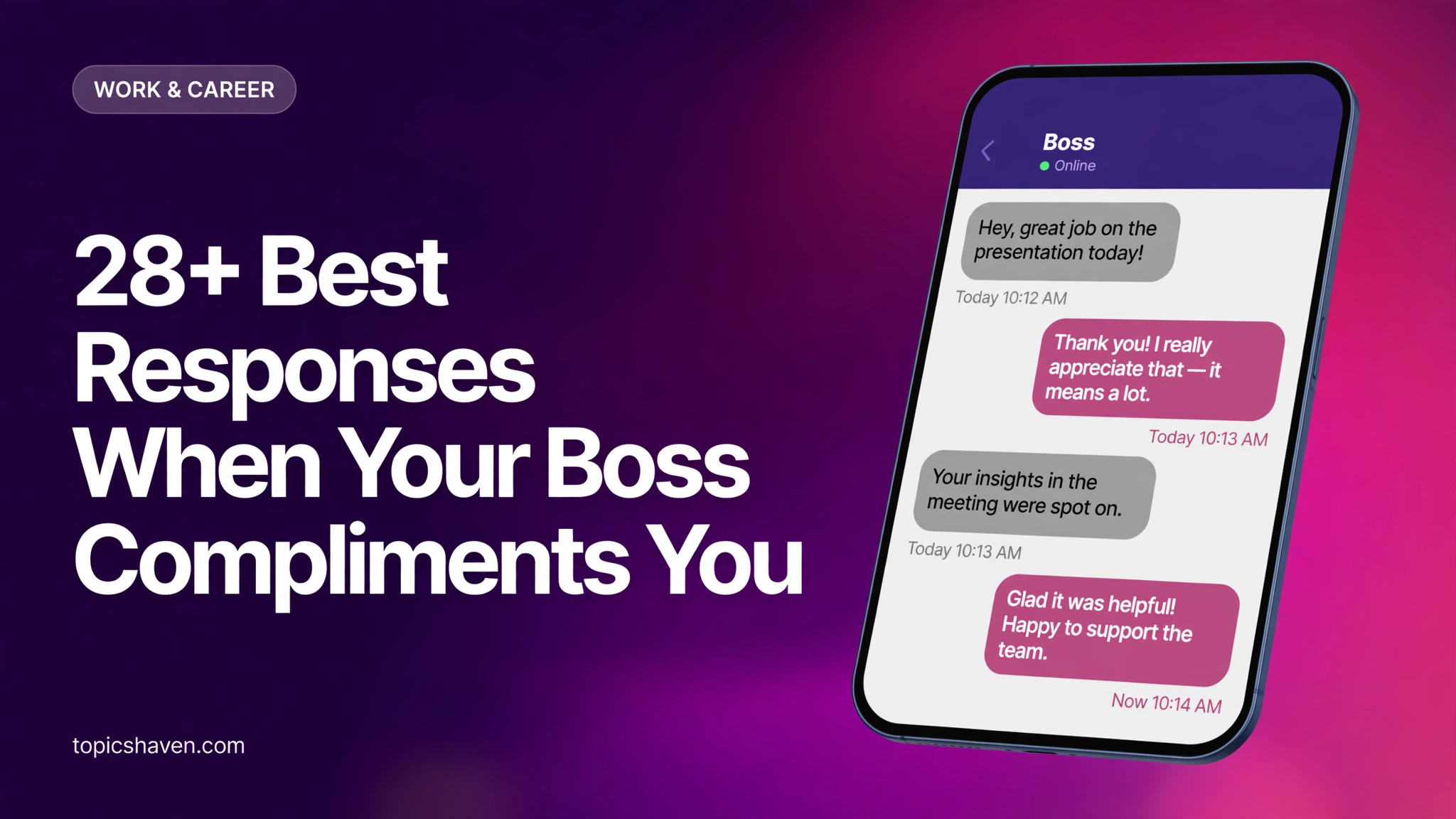
    “Great work on that presentation.” Your boss compliments you, and instead of feeling good, you feel awkward. You deflect, you joke, you mumble “it was nothing.” Sound familiar? Most of us are terrible at receiving praise. The best responses when your boss compliments you are short and confident: accept it, appreciate it, and move on. Below are 22 copy-and-paste replies that make accepting a compliment feel natural, from casual praise to performance-review kudos.

    ๐Ÿ“Œ Jump to

    Simple Ways to Accept a Compliment

    No overthinking needed. These one-liners accept any compliment gracefully, in any setting.

    1. “Thank you, that made my day.”
    2. “I really appreciate you saying that.”
    3. “Thank you! It means a lot coming from you.”
    4. “That’s so kind, thank you.”
    5. “I’m glad to hear that. Thank you!”

    Compliments on a Project or Result

    When the praise is about something you poured effort into, let a little pride show, you earned it.

    1. “Thank you, I put a lot of thought into it, so I’m glad it landed.”
    2. “I appreciate that! It was a challenging one, and I’m proud of the outcome.”
    3. “Thank you, hearing that makes the late nights worth it.”
    4. “I’m really happy with how it turned out. Thanks for noticing.”
    5. “Thank you! I’ll keep that momentum going.”

    Compliments on Your Skills or Qualities

    Compliments about who you are, your leadership, your creativity, your work ethic, deserve more than a shrug.

    1. “Thank you, that’s something I genuinely work on.”
    2. “I appreciate that. I’m always trying to get better at it.”
    3. “That means a lot. Thank you for recognizing it.”
    4. “Thank you! I take pride in that.”

    When the Compliment Belongs to the Team Too

    Accept first, then share. Taking the compliment before passing it on shows confidence, not selfishness.

    1. “Thank you, and honestly, the team deserves the credit on this one.”
    2. “I appreciate it! Everyone worked hard; I’ll share your kind words.”
    3. “Thank you! I’d love to pass this on to the team.”
    4. “It was a team effort, but thank you for noticing.”

    Replies for Compliments in a Performance Review

    In a review, don’t just accept praise, connect it to your growth. That’s what turns a compliment into career momentum.

    1. “Thank you for highlighting that, I’d like to keep building on it.”
    2. “I appreciate the recognition. What areas should I focus on next?”
    3. “Thank you. This feedback helps me know I’m on the right track.”
    4. “I’m glad it stood out. I’m excited to take it further next quarter.”

    Tips for the Perfect Reply

    • Don’t deflect: “It was nothing,” “I just got lucky,” and “Anyone could’ve done it” all tell your boss the praise was wasted. Let the compliment land.
    • Smile and say thanks: Body language does half the work. A genuine smile plus “thank you” tells the giver their words mattered.
    • Redirect misdirected praise: If the compliment was really someone else’s work, say so warmly: “Thank you, actually, that was all Sarah’s doing.” Honesty earns more respect than stolen credit.
    • Keep it short: One or two sentences is plenty. A long, gushing response makes the moment awkward for both of you.
    • Ask what’s next: In reviews especially, turn praise into direction: “Thank you, where should I focus next?” It shows ambition, not arrogance.
    • Learn the etiquette: Career experts list the best ways to respond to a compliment at work, and the golden rule is always the same: accept it graciously, then move on.

    Frequently Asked Questions

    Why do compliments from my boss feel so awkward?

    Because most of us were never taught to receive praise, we’re trained to be modest, so compliments trigger a weird mix of pride and guilt. Remember: your boss chose to say it. Accepting it graciously respects their gesture instead of rejecting it.

    Should I compliment my boss back right away?

    Resist the urge. An instant return compliment can sound forced and may even cheapen the praise you just received. Accept theirs fully; save your genuine praise of them for a separate, natural moment.

    How do I reply to a compliment email from my boss?

    Keep it to three lines: thank them, note what you’re glad landed well, and sign off. Example: “Thank you for the kind note, I’m glad the report hit the mark. Appreciate your feedback!” Short, warm, done.

    Final Thoughts

    A compliment from your boss is a gift, the only wrong response is refusing to open it. Say thank you, mean it, and let it fuel your confidence for the next challenge. If compliments still leave you tongue-tied, our guide on what to say when you don’t know what to say will help, and the free Reply Finder tool at Topicshaven is always there when you’re stuck for words.
  • 30+ Best Responses When Your Boss Congratulates You (100+ Examples)

    30+ Best Responses When Your Boss Congratulates You (100+ Examples)

    30+ Best Responses When Your Boss Congratulates You (100+ Examples)

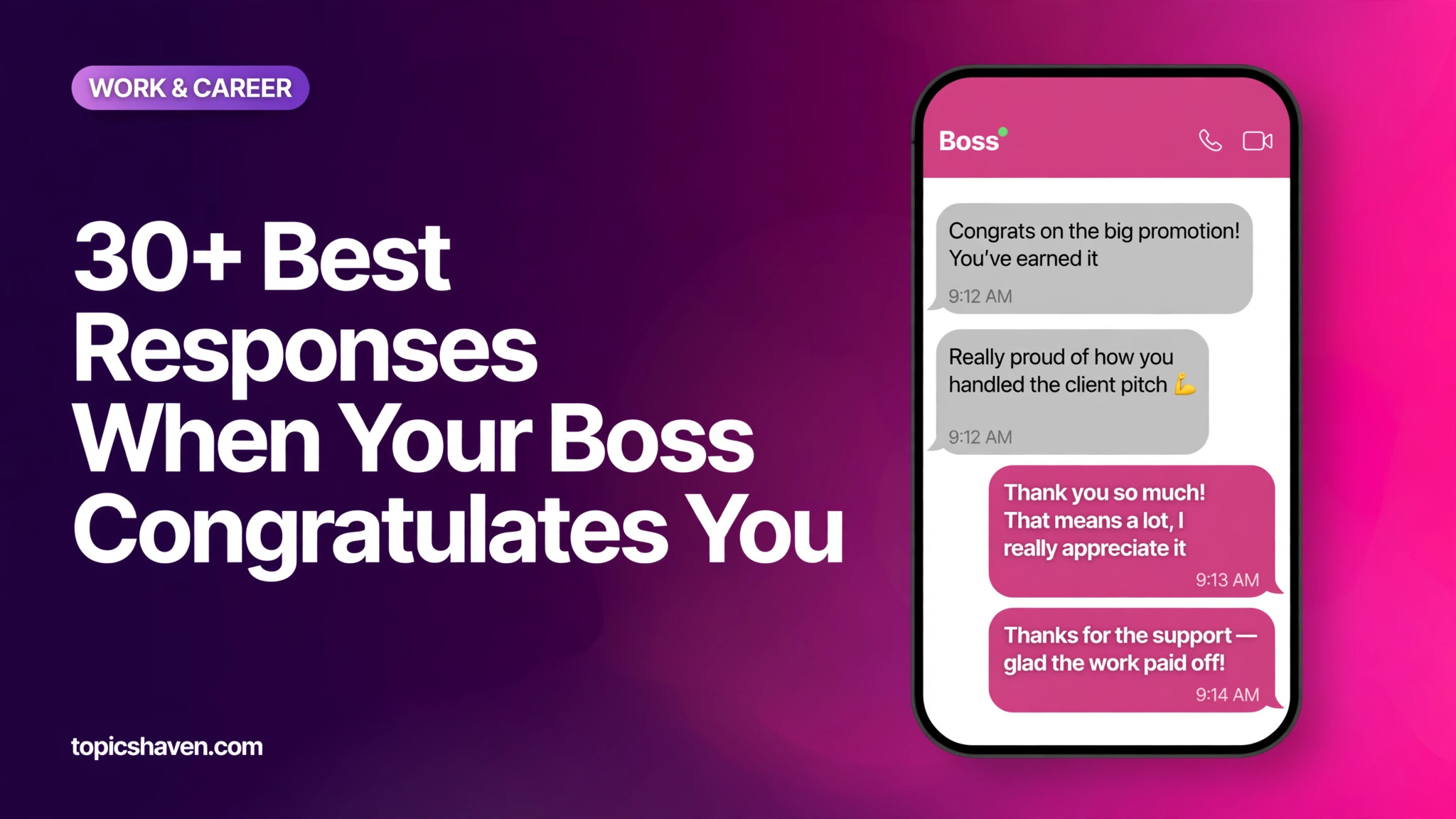
    Your boss just congratulated you, on a finished project, a big win, a milestone, and suddenly you’re not sure what to say. Too modest and you sound like you don’t value the recognition; too proud and you sound arrogant. The best responses when your boss congratulates you are simple: accept it warmly, share the credit, and show you’re hungry for what’s next. Below are 22 copy-and-paste replies for every channel, from hallway praise to congratulatory emails.

    ๐Ÿ“Œ Jump to

    Simple, Gracious Thank-Yous

    You can never go wrong with a sincere “thank you.” These short replies work in person, on Slack, or over text.

    1. “Thank you so much, that really means a lot coming from you.”
    2. “I appreciate that! It was a team effort all the way.”
    3. “Thank you! I’m really proud of how it turned out.”
    4. “That means a lot. Thank you for noticing.”
    5. “Thanks! I’m grateful for the opportunity to work on it.”

    Replies That Share Credit With Your Team

    Leaders notice who lifts the team up. Sharing credit doesn’t shrink your achievement, it multiplies it.

    1. “Thank you! I couldn’t have done it without the team’s hard work.”
    2. “I appreciate it, everyone really pulled together on this one.”
    3. “Thank you. I was lucky to work with such a strong team.”
    4. “It was a group win, I’ll pass your kind words on to everyone.”
    5. “Thanks! The credit belongs to the whole team.”

    Replies That Show You’re Motivated for What’s Next

    Pair gratitude with forward energy. Bosses love hearing that recognition fuels you, not that it makes you coast.

    1. “Thank you! This has me fired up for the next challenge.”
    2. “I appreciate that, and I’m already thinking about how to top it.”
    3. “Thank you. I’m excited to keep raising the bar.”
    4. “That motivates me even more. On to the next one!”

    Replies for a Congratulatory Email or Message

    Written congratulations deserve a written reply, short, warm, and personal. Match their effort, not their word count.

    1. “Thank you for the kind note, I’m glad the project made an impact.”
    2. “I really appreciate you taking the time to write this.”
    3. “Thank you! Your support throughout made all the difference.”
    4. “Grateful for the recognition, and for your guidance on this.”

    Warm Replies for a Public Shout-Out

    When the praise happens in front of everyone, a meeting, a group chat, a company-wide email, keep it humble, warm, and brief.

    1. “Thank you! Honored to be recognized, and proud of our team.”
    2. “This means so much. Thank you for the shout-out!”
    3. “Thank you! I’ll keep working hard to live up to it.”
    4. “Appreciate it! Couldn’t ask for a better team to share this with.”

    Tips for the Perfect Reply

    • Say thank you first: Lead with gratitude before anything else. “Thank you” is the whole foundation, everything after it is a bonus.
    • Accept it, don’t deflect: “It was nothing” or “I just got lucky” dismisses the recognition your boss took time to give. Own the win.
    • Share credit genuinely: Name the team when you can. People who spread praise around are the ones leaders remember for bigger things.
    • Match the channel: Got a thoughtful email? Reply by email. Got a public shout-out? Thank them where everyone can see. Mirroring the channel shows respect.
    • Add forward momentum: Pair your thanks with enthusiasm for what’s next. “This motivates me for the next one” turns praise into promise.
    • Know the etiquette: Harvard Business Review’s guide on how to give and receive compliments at work shows that simply saying “thank you”, and meaning it, beats every clever deflection.

    Frequently Asked Questions

    What’s the best short reply when my boss congratulates me?

    “Thank you so much, that means a lot.” It’s warm, confident, and complete. You can stop there, or add one line about the team or what’s next. Anything longer risks sounding like you’re justifying the praise instead of accepting it.

    Should I reply when congratulations come in a group message?

    Yes, briefly. A short “Thank you all! Proud of what the team accomplished” in the same thread is perfect. Keep it to one message; a long speech in a group chat feels like you’re performing instead of appreciating.

    Is it okay to share credit when my boss congratulates me personally?

    Absolutely, as long as it’s genuine. “Thank you, the team made it possible” shows leadership character. Just don’t use the team as a shield to avoid accepting praise; own your part first, then spread the credit.

    Final Thoughts

    Congratulations from your boss are a career asset, how you receive them shapes how you’re seen. Accept praise with confidence, spread the credit, and let the moment fuel your next win. If you ever freeze up on the perfect words, see our guide on what to say when you don’t know what to say, and the free Reply Finder tool at Topicshaven has your back for every tricky conversation.

  • 26+ Best Responses When Your Boss is Condescending (100+ Examples)

    26+ Best Responses When Your Boss is Condescending (100+ Examples)

    26+ Best Responses When Your Boss is Condescending (100+ Examples)

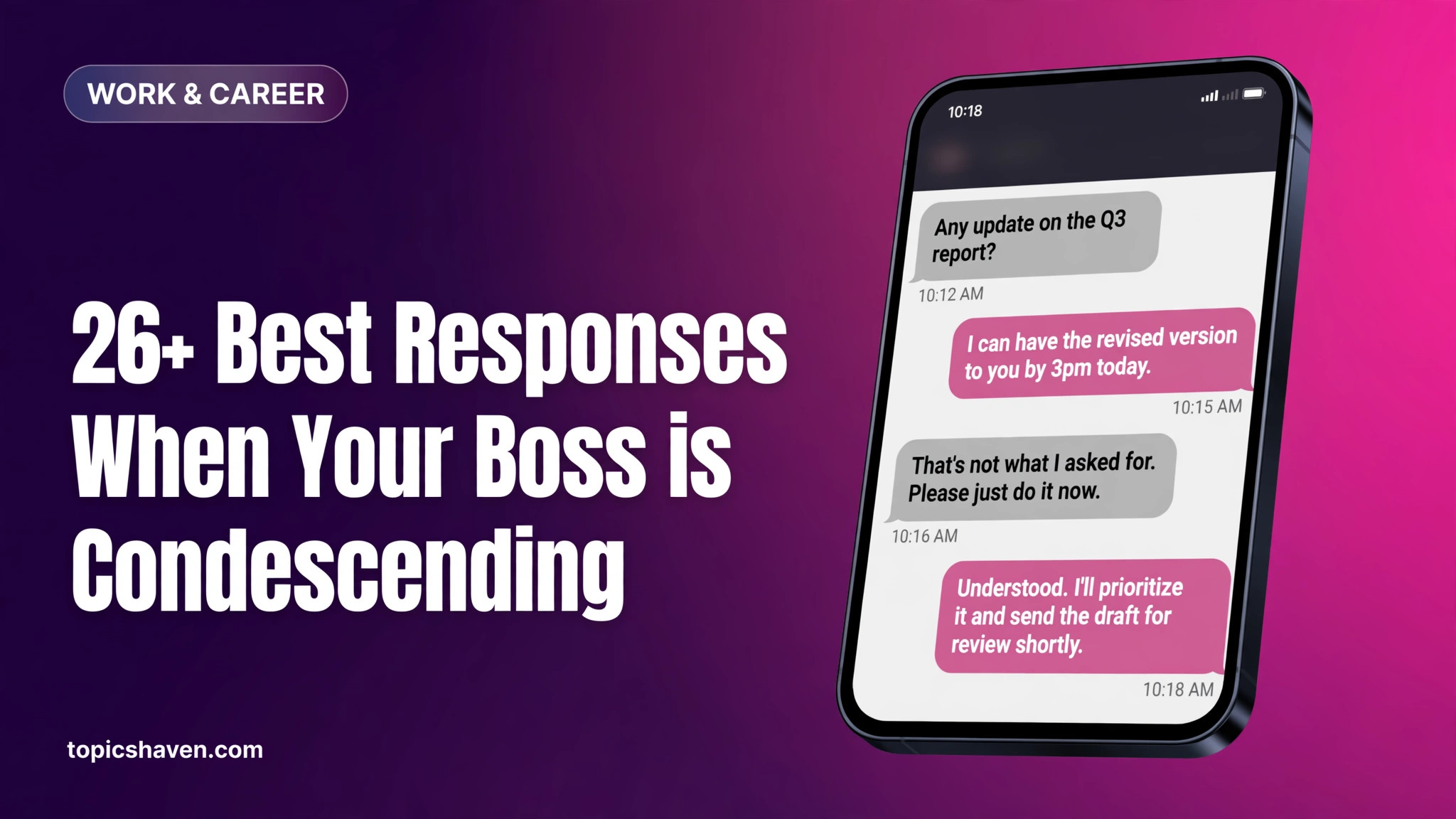
    Few things sting like a boss who talks down to you, the over-explaining, the patronizing tone, the comments that imply you can’t handle your own job. When your boss is condescending, your response sets the tone for every future conversation. Staying calm and professional isn’t weakness; it’s strategy. Below are 22 copy-and-paste responses when your boss is condescending, organized by situation so you can protect your dignity without risking your career.

    ๐Ÿ“Œ Jump to

    Polite Deflections That Keep Things Professional

    Sometimes the smartest move is to rise above it. These replies shut down the patronizing moment without creating a scene.

    1. “Thank you for the overview, I’ve got this part covered.”
    2. “I understand the concept. Let’s focus on the next step.”
    3. “Got it, no extra breakdown needed. Moving on.”
    4. “I appreciate the recap. I’ll take it from here.”
    5. “Understood. I’m all set on this piece.”

    Replies That Calmly Assert Your Competence

    Condescension thrives on the assumption that you don’t know what you’re doing. These replies correct that assumption with facts, not feelings.

    1. “I’m familiar with this process, here’s where I am on it.”
    2. “I’ve already considered that part. Here’s my take.”
    3. “I follow completely. Here’s what I’d suggest.”
    4. “I’ve got a good handle on this. Let me show you the progress.”
    5. “I know this area well, the data backs my approach here.”

    Replies That Ask for Clarification (Without Accusation)

    Asking “what do you mean?” in a neutral tone forces a condescending remark into the light, where it usually can’t survive.

    1. “I’m not sure I’m following, can you elaborate on what you mean?”
    2. “Just so I’m clear, are you saying I’m not able to handle this task?”
    3. “Help me understand: what outcome are you looking for here?”
    4. “Can you walk me through what concerns you about my approach?”

    Replies for a Private Conversation About the Pattern

    If it’s a pattern, one private conversation beats a hundred clever comebacks. Use “I” statements and speak to the behavior, not the person.

    1. “I wanted to mention something, lately your tone with me has felt dismissive. Can we talk about it?”
    2. “I value your feedback, and I want to do my best work. When the tone feels patronizing, it’s hard for me to focus on the message.”
    3. “I feel undermined when my ideas are dismissed without discussion. I’d like us to find a better way to work together.”
    4. “I respect your experience, and I’d like to ask respectfully that we keep our conversations professional.”

    Replies When It’s Crossed a Line

    Condescension that becomes belittling or public humiliation is no longer a communication style, it’s a problem. Draw the line clearly.

    1. “I’d like to ask you respectfully not to address me in that way.”
    2. “That comment felt disrespectful. Can we keep this professional?”
    3. “I’m happy to discuss the work, but not like this. Let’s reset.”
    4. “I’ve raised this before. If it continues, I’ll need to bring it up with HR.”

    Tips for the Perfect Reply

    • Pause before you react: A beat of silence after a patronizing comment gives you control of your emotions, and often makes the other person hear their own words.
    • Don’t match the condescension: Sarcasm, muttering, or eye-rolls feel good for a second but cost you the high ground. Staying calm is what makes you look strong.
    • Focus on the work, not the tone: Redirect every exchange to facts, data, and next steps. Competence is the quietest and most effective comeback.
    • Document the pattern: If it keeps happening, note dates, times, and exact quotes. Written records turn a “feeling” into evidence if HR ever needs to get involved.
    • Talk to a mentor first: Get an outside read from someone you trust before confronting your boss, they may spot context or solutions you’re too close to see.
    • Learn the playbook: Career experts explain how to deal with a condescending boss, from in-the-moment deflections to the private conversation that fixes the pattern.

    Frequently Asked Questions

    Should I confront my boss about being condescending?

    Yes, but privately, and with “I” statements, not accusations. Say how the tone affects your work rather than labeling your boss. Most people don’t realize they sound condescending, and a calm private conversation fixes the pattern more often than you’d expect.

    How do I respond to a condescending comment without sounding rude?

    Ask a neutral clarification question: “Can you elaborate on what you mean?” It forces the remark into the open without any hostility, and it gives your boss a chance to correct an unintended offense. Pair it with a calm, steady tone.

    When should I take a condescending boss to HR?

    When the behavior is persistent, you’ve addressed it directly, and you have documentation (dates, quotes, witnesses). HR needs a pattern, not a single bad day. If the condescension includes insults, public humiliation, or discrimination, go sooner.

    Final Thoughts

    A condescending boss says more about their leadership than your ability. Respond with calm professionalism, document what matters, and address the pattern directly when you’re ready. For more help with difficult workplace moments, see our guides on what to say when someone disrespects you and when you don’t know what to say, and the free Reply Finder tool at Topicshaven is always there when you’re stuck for words.
  • 31+ Best Responses When Your Child Says I Hate You (100+ Examples)

    31+ Best Responses When Your Child Says I Hate You (100+ Examples)

    31+ Best Responses When Your Child Says I Hate You (100+ Examples)

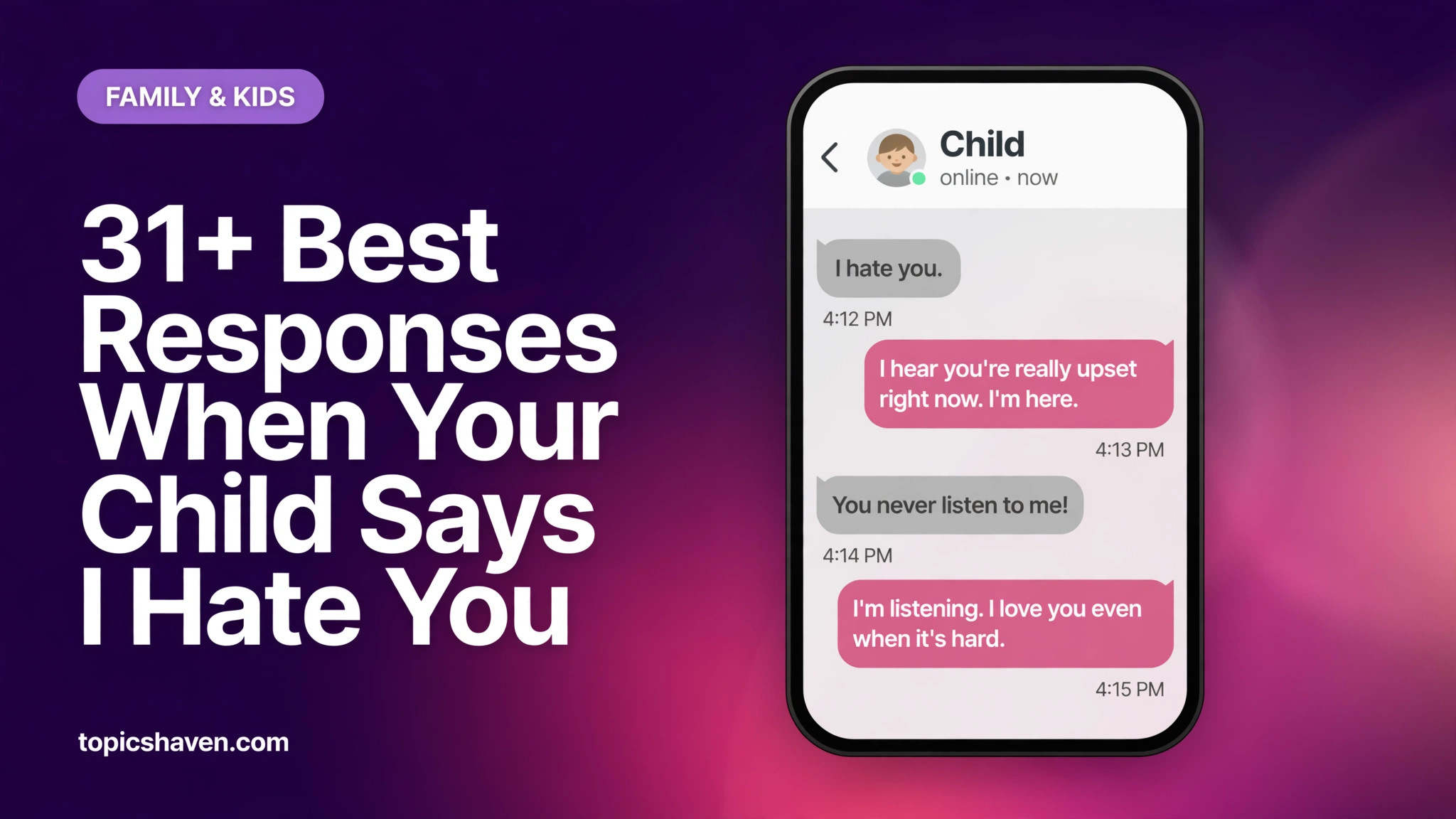
    Hearing “I hate you” from your own child can feel like a punch to the heart, even when you know it’s just big feelings in small words. Kids between 2 and 10 say it because their emotional vocabulary hasn’t caught up with their emotional experience. The right responses when your child says “I hate you” can turn a meltdown into a moment of connection. Below are 22 copy-and-paste replies, organized by age and situation, so you can stay calm and keep your bond strong.

    ๐Ÿ“Œ Jump to

    Calm, Loving Replies for a Toddler

    Toddlers borrow big adult words to describe huge feelings. Stay short, stay warm, and don’t try to reason mid-storm.

    1. “I hear you. You’re really upset right now, and I love you.”
    2. “That’s a big feeling. I’m right here with you.”
    3. “You sound so angry. It’s okay, I’m not going anywhere.”
    4. “I love you, even when you’re mad.”
    5. “Those are loud feelings. Let’s breathe together.”

    Replies That Validate the Feeling, Not the Words

    Child psychologists call this “connect before you correct”, acknowledge the emotion first, and the hurtful words lose their power.

    1. “I can tell you’re really angry. I love you anyway.”
    2. “You don’t have to love me right now, but I will always love you.”
    3. “It sounds like something feels really unfair to you.”
    4. “I hear the anger behind those words. Tell me what’s wrong.”
    5. “Your feelings are okay. Those words hurt, though, can we try different ones?”

    Replies for a School-Age Kid in a Big Meltdown

    School-age kids are old enough to feel embarrassment on top of anger. Give them space, dignity, and a door back in.

    1. “I’m going to wait right here until you’re ready to talk.”
    2. “We can talk about this when the feelings aren’t so loud.”
    3. “I understand you’re angry at me, and it’s okay to be angry.”
    4. “I love you too much to let big feelings win tonight.”

    Replies for a Teen Testing Boundaries

    Teens use “I hate you” to test whether love survives conflict. Hold the boundary and the relationship at the same time.

    1. “I get that you’re furious. You still can’t talk to me that way.”
    2. “I’m not going to fight with you, but I’m not walking away either.”
    3. “Say it differently and I’ll listen. I’m here.”
    4. “You can be angry and still be respectful, I know you can do both.”

    What to Say Later, When Everyone’s Calm

    The real teaching moment comes after the storm passes. A calm follow-up turns a rough day into a lesson they’ll keep.

    1. “Earlier was tough. Want to tell me what was really going on?”
    2. “I wasn’t scared by your anger, but I was a little sad. Can we figure this out together?”
    3. “Next time you’re that mad, try saying ‘I’m so angry’ instead. I’ll listen faster.”
    4. “No matter how mad we get, we’re still a team. Okay?”

    Tips for the Perfect Reply

    • Stay calm first: Your nervous system sets the tone for the whole house. Take one slow breath before you speak, your child will borrow your calm.
    • Don’t take the words personally: Psychologists point out that kids save their biggest outbursts for the safest person in the room, that’s you, and it’s actually a sign of trust.
    • Connect before you correct: Name the feeling (“You’re furious”) before you address the language (“We don’t use those words”). The feeling needs a listener; the words need a boundary.
    • Never say it back: Even as a joke, “I hate you too” lands like a brick on a flooded brain. Say “I love you” instead, it takes the power out of the phrase.
    • Don’t cave on the boundary: Giving in right after “I hate you” teaches your child that the phrase works. Hold the limit warmly, then reconnect.
    • Get the expert playbook: Child psychologists break down how to react when your child says “I hate you”, empathy first, respectful boundaries always.

    Frequently Asked Questions

    Is it normal for a child to say “I hate you”?

    Yes, completely normal, especially between ages 2 and 10. Children’s brains develop big emotions long before they develop the vocabulary to express them, so “I hate you” becomes the loudest word they have. It usually means “I’m overwhelmed,” not “I reject you.”

    Should I punish my child for saying “I hate you”?

    Punishing the words doesn’t teach better words, it just teaches your child to hide big feelings. Address the language calmly later (“In our family we say ‘I’m angry’ instead”), but treat the outburst itself as a signal that your child needs help, not punishment.

    What if my child says it every single day?

    If it becomes constant, or comes with aggression, withdrawal, or trouble at school, look for what’s underneath, stress, sleep issues, or something they’re struggling to name. A calm daily check-in helps, and a child counselor is worth a visit if the pattern won’t shift.

    Final Thoughts

    An “I hate you” from your child is really code for “I’m overwhelmed and I need you.” Answer with calm, love, and a clear boundary, and you’ll teach them that love survives even the loudest feelings. For more help with tough parenting moments, see our guides on what to say when your child says hurtful things and when your child is disrespectful, and the free Reply Finder tool at Topicshaven is always there when you’re stuck for words.
  • 27+ Best Responses When Your Child Hits You (100+ Examples)

    27+ Best Responses When Your Child Hits You (100+ Examples)

    27+ Best Responses When Your Child Hits You (100+ Examples)

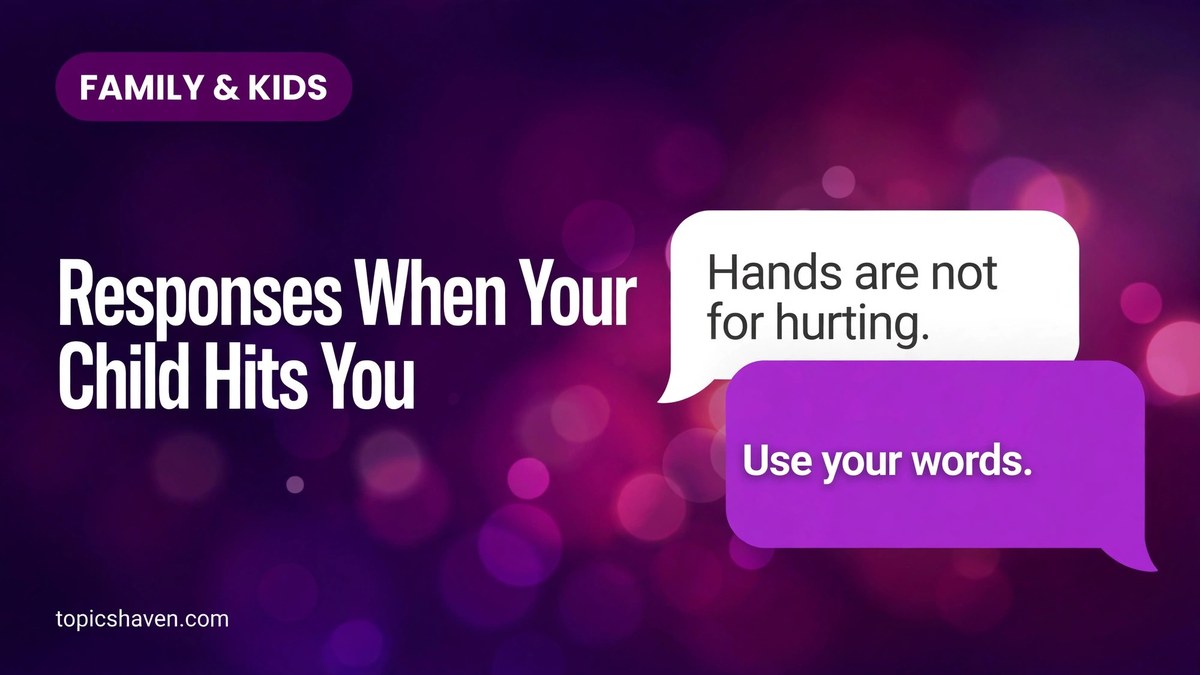
    A little hand swings at your face, and your first instinct is shock, so here are the 27+ Best Responses When Your Child Hits You (100+ Examples), short, steady scripts you can say out loud instead of freezing or blowing up. These aren’t lectures or shaming one-liners. They stop the hit calmly, set the unshakable rule that hands are not for hurting, and teach your child what to do with those big feelings instead. For related tough moments, these responses when your child is disrespectful can help too.

    ๐Ÿ“Œ Jump to

    The 27+ Best Responses When Your Child Hits You for the Heat of the Moment

    Act first, talk second. These replies stop the behavior calmly while you get down to eye level, exactly what child-development experts say works best when your child hits you.

    1. “Whoa, I’m going to hold your hands so everyone stays safe.”
    2. “I won’t let you hit me. Hitting hurts.”
    3. “Pause. I’m moving your hands gently so you can’t hit again.”
    4. “Stop. I can see you’re upset, and hitting is not allowed.”
    5. “I’m going to step back so my body stays safe. We’ll talk when we’re calm.”

    Replies That Name the Rule and the Feeling

    Once hands are stopped, name two things: the rule, and the feeling behind the hit. Kids hit because the feeling has no words yet, so you give them the words.

    1. “Hands are not for hurting. Hands are for hugging, clapping, and building.”
    2. “You hit me because you’re angry. I hear you, you don’t have to hit.”
    3. “It sounds like you’re frustrated. Say it with words: ‘I’m mad!’”
    4. “In our family, we never hit. We can be furious, and we still don’t hit.”
    5. “That hurt my body. You can feel mad without making my body hurt.”

    Here’s what it sounds like in real life:

    You: “Whoa, I’m holding your hands so everyone stays safe.”
    Child: “No! I’m mad at you!”
    You: “You’re mad, and mad is okay. Hitting is not. Tell me what made you mad.”

    Replies That Teach Replacement Words

    A child who knows what to say doesn’t need to swing. Save these lines for after the storm passes, when your child is calm enough to learn.

    1. “Next time you feel that mad, say: ‘Stop! I don’t like that.’”
    2. “Try these words: ‘I’m angry and I need space.’ Let’s practice them together.”
    3. “You can stomp your feet or squeeze a pillow. Your words and safe choices can carry the big feeling.”
    4. “Hitting told me you’re upset, but your words tell me why. Words help me fix it.”

    Redirect and Reset Replies

    When the body is still buzzing, give the feeling somewhere to go. Redirecting the energy works faster than arguing about the hit.

    1. “Let’s go get some cold water together and reset. We can talk after.”
    2. “Show me how strong your feet are, let’s stomp the angry out right here.”
    3. “Do you want a hug, or do you want space? Either way, we use no hitting.”
    4. “Let’s press our hands together hard instead of using them to hit. Push, push, there it goes.”

    Another real moment:

    Child: (raises hand, breathing fast)
    You: “I won’t let you hit me. Here’s your pillow, hit this instead. Your mad has to go somewhere safe.”

    Short One-Line Rules

    Short is powerful. One calm sentence, repeated every time, becomes the rule your child hears in their own head.

    1. “Hands are not for hurting.”
    2. “I won’t let you hit me.”
    3. “Mad is okay. Hitting is not.”
    4. “Use your words, not your hands.”

    Tips for Responding When Your Child Hits Without Shaming

    • Stop it calmly before you say anything else: Child-development experts advise stopping the behavior first with a steady voice and gentle hands, not a lecture. A calm “I won’t let you hit me” teaches more than a long scolding ever could.
    • Get down to eye level: Crouching down signals safety, not a power battle. Your child hears the words better when your face is close and your body is relaxed instead of towering over them.
    • Use one short script every time: Pick one line, “Hands are not for hurting”, and repeat it word for word after every hit. Consistency turns your sentence into the rule they eventually say to themselves.
    • Understand why it happens: Kids hit for real, readable reasons, frustration, tiredness, testing boundaries, or big feelings with no words yet. These parenting tips on why kids hit explain the common causes so you can spot your child’s trigger.
    • Teach alternatives only after they’re calm: A mid-meltdown brain can’t learn new scripts. Wait until the storm passes, then practice the replacement words and safe choices so the next big feeling has somewhere to go.
    • Never hit back or shame them: Hitting back teaches that bigger people solve problems with hitting, and labels like “bad kid” stick longer than any lesson. Repair the moment instead: “We don’t hit. Let’s make it right.”

    Frequently Asked Questions

    What should I say right after my child hits me?

    Keep it to three short moves: stop the hit calmly (“I won’t let you hit me”), state the rule (“Hands are not for hurting”), and name the feeling (“You look really angry”). Save the teaching, the replacement words and alternatives, for after your child is calm, when their brain can actually take it in.

    Is it normal for toddlers to hit their parents?

    Yes, hitting is very common between ages 1 and 4 because toddlers have huge emotions and tiny vocabularies, so the hand moves faster than the words can form. It doesn’t mean you’re failing or your child is “bad.” It means they need repeated, calm coaching on what to do with the feeling instead.

    What should I not do when my child hits?

    Don’t hit back, don’t yell a long lecture, and don’t label your child (“you’re a hitter”), all three model the very behavior you’re trying to stop and can deepen the shame cycle. If your child’s words get cruel while they’re upset, these responses when someone says something mean can help you stay steady. And when their temper is the real driver, these responses when someone is angry walk you through defusing it.

    Final Thoughts

    Being hit by your child doesn’t make you a bad parent, it makes you a parent dealing with a normal, fixable behavior. Pick the replies that fit your voice, say them calmly every single time, and trust that the repetition is doing the real work. For any other tricky family moment, the free Reply Finder tool at Topicshaven has your back.